The US Divorce Process, Explained Simply
Going through divorce can feel overwhelming, especially when you’re navigating a new legal system. This guide explains the US divorce process in plain language so you know what to expect and what to do next.
- Free to request
- No obligation
- Your information stays private
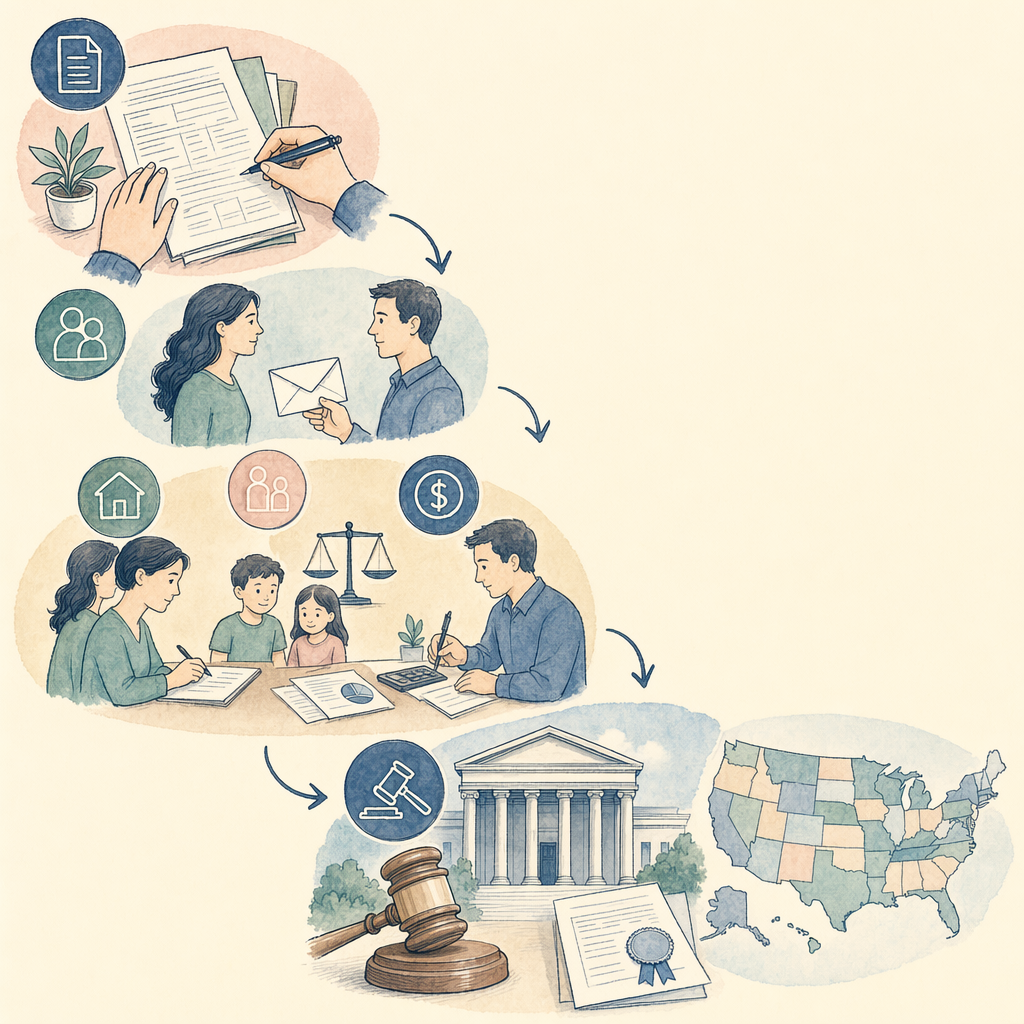
First, a quick note: family law varies by state
Divorce rules are not exactly the same everywhere in the United States. Steps, forms, timelines, and even terms can change based on your state.
This page gives general information about how divorce usually works. For advice about your situation, you can talk with a qualified family-law attorney in your area. Next Page Family is a free service that helps you find one.
- If you tell us your state, we can help you connect with an attorney who practices there.
- You can also browse our guides to learn common terms and next steps.
Step 1: Meet the basic requirements to file

Most states require that at least one spouse meets a residency requirement. Residency rules can be based on how long you’ve lived in the state.
Some states also require that the divorce be based on certain legal reasons (often called “grounds”). Many places allow a no-fault divorce, but the exact wording and requirements differ.
If you’re not sure whether you qualify to file where you live, ask a family-law attorney. Even a short consultation can help you understand your options.
Step 2: Choose the type of divorce (and how people usually handle it)
Many couples divorce through a process called “contested” or “uncontested,” depending on whether you and your spouse agree on major issues.
If you can agree on key topics—like parenting time, child support, spousal support, and property division—you may be able to move through the process with fewer disputes. If you do not agree, your case may take longer and may involve more court steps.
There are also options like mediation or settlement-focused discussions. These can sometimes help families resolve issues more peacefully, but the best choice depends on your safety, your situation, and your state’s rules.
Step 3: File divorce papers and serve your spouse
To start a divorce, one spouse (often called the “petitioner”) files divorce forms with the court. The other spouse (often called the “respondent”) must be officially notified.
That official notice is usually done through a process called “service of process.” Your state may have specific rules for how service must happen and who is allowed to serve the papers.
A common reason divorce timelines get delayed is incorrect or incomplete paperwork or service problems. Many people find it helpful to get help reviewing forms before filing.
Step 4: The initial court stage (temporary orders may happen)
After the divorce is filed and your spouse is served, the case moves into early court stages. Depending on your state, you may have deadlines to respond.
In some cases, either spouse asks for temporary orders. These are short-term court decisions that can cover things like child custody/visitation schedules, child support, spousal support, and sometimes how bills or housing are handled while the divorce is still in progress.
Temporary orders can matter a lot for day-to-day life. If you’re concerned about safety, housing, or the care of children, a family-law attorney can explain what requests are possible in your state.
Step 5: Gather information and negotiate or litigate key issues
Most divorce cases require decisions about major topics. These commonly include:
- Parenting time and decision-making for children
- Child support
- Spousal support (alimony), if applicable
- Division of property and debts
Some couples work out agreements with each other, sometimes with help from attorneys, mediation, or settlement discussions. Other cases involve court hearings where the judge decides issues.
Even if you want to settle, it helps to understand what information the court may need. Your attorney can guide you on documentation and what to bring.
Step 6: Final hearing and the divorce judgment
When the divorce is ready to be finalized, the court issues a final order or judgment. This is the document that officially ends the marriage and sets out the rules for parenting, support, and division of property.
After the final judgment, there are usually steps to follow, such as completing required payments, signing related documents, or complying with parenting plans.
Every state has different rules about timing and what must happen for the divorce to become final. If you have questions about the process in your state, connect with an attorney using get matched. You can also explore more basics in our divorce services page.
Common documents and terms you may hear
Divorce involves legal forms and court language. Terms may vary by state, but you may hear about:
- Petition / Complaint: the initial filing asking for divorce
- Response: the other spouse’s reply
- Custody or parenting plan: how parents share time and make decisions
- Child support: court-ordered financial support for children
- Property division: how assets and debts are divided
- Discovery: information exchange during the case (your state may use different procedures)
If English is not your first language, ask the court or your attorney about language access. You may also want to bring a trusted person for translation support if the rules allow it.
For more helpful explanations, visit our guides.
How to prepare while your divorce is pending
Divorce is stressful. It can also be a time when details matter.
Consider making a simple checklist: where you live, your children’s schedules, basic income information, major expenses, shared debts, and important documents. If you can, keep copies of pay statements, banking records, leases or mortgages, and any child-related records.
Also think about communication. It’s often best to keep messages respectful and focused on parenting and logistics, especially if a court order is possible. If you feel unsafe, prioritize safety first and ask about protective options through a qualified family-law attorney.
Questions people ask
How long does a divorce take in the US?
Timelines vary a lot by state and by case type. Factors like how quickly paperwork is filed, whether your spouse responds, and whether you agree on key issues can all affect the schedule.
Do I have to go to court?
Some divorces can be finalized with fewer court appearances if both sides agree and follow the required steps. Other cases require hearings and a judge’s decision. Your state’s rules will guide what’s typical.
What happens to children during divorce?
Courts often decide parenting time and decision-making. In some cases, temporary orders are issued early so children’s schedules stay stable while the divorce is ongoing.
Can we divorce if we don’t agree on everything?
Yes, many couples divorce even when they disagree. If you can’t reach agreements, the case may move toward court decisions on issues like parenting, support, or property.
What should I do first if I’m worried about paperwork or deadlines?
Start by learning your state’s basic requirements and deadlines, and consider getting help reviewing your forms. Connecting with a qualified family-law attorney can help you avoid mistakes that can delay your case.
How can Next Page Family help me?
Next Page Family is free for readers. We help you find a qualified family-law attorney in your area and share plain-language divorce guidance to help you understand the process.
Keep reading
Your Rights in a Divorce
A plain-language guide to your rights in a divorce for people navigating family law in the
Learn more GuideDivorce and Your Immigration Status
A plain-language guide to divorce and your immigration status for people navigating family
Learn more GuideHow Much a Divorce Costs
A plain-language guide to how much a divorce costs for people navigating family law in the
Learn moreNot sure where to start?
Tell us what you need and we'll connect you with a qualified family-law attorney near you. Free to request, no obligation, in your language.