Co-Parenting Plan Starter
Co-parenting can feel overwhelming. This starter tool gives you a clear template to organize your parenting plan basics, so you and your co-parent can discuss what works for your family—step by step.
- Free to request
- No obligation
- Your information stays private
A quick note before you start
This is a free, plain-language template to help you organize a co-parenting plan. It’s general information, not legal advice, and it may not match your state’s rules.
Family law and court forms vary by state. If you’re not sure what your state requires, you can use our guides to learn the common basics and then connect with a qualified family-law attorney through get matched for guidance on your situation.
Even if you’re aiming for an agreement outside of court, a clear plan can reduce confusion and help children feel steadier.
Parenting Plan Starter (template you can copy)
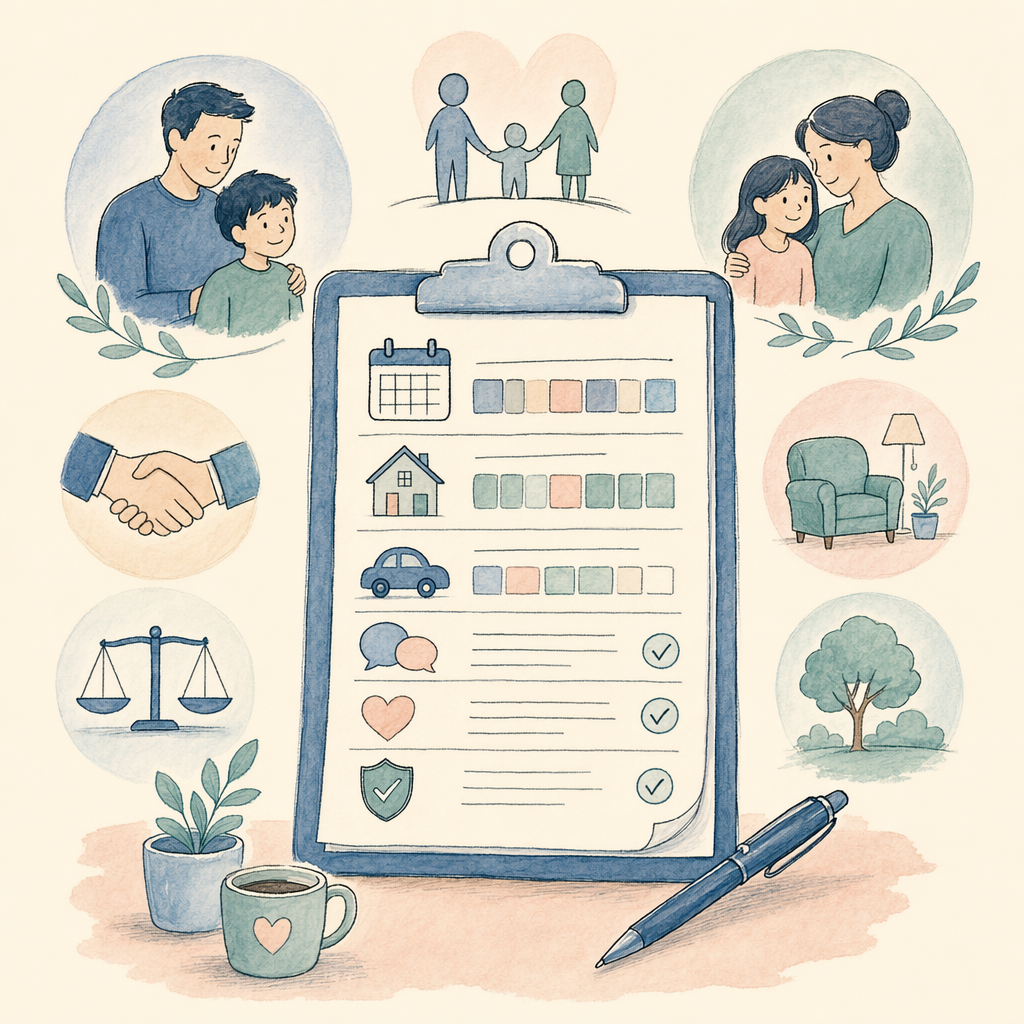
Use this template as a starting point. Replace the bracketed words with your details. You can also print it and fill it out together if it’s safe to do so.
If you already have a court order, treat this as a discussion tool—not a replacement—until an attorney or the court confirms changes.
---
1) Families and contact information
• Parent A full name: [_____]
• Parent B full name: [_____]
• Child(ren): [name, birth date]
• Primary address for Child(ren) (if relevant): [_____]
• Phone numbers (best method): [_____]
• Email (best method): [_____]
• Preferred communication method: [text / email / app / phone]
• Language needs (if any): [_____]
2) Start date and review plan
• This plan starts on: [date]
• Review schedule (example: every 6 or 12 months, or after major changes): [_____]
• If something changes (school, work schedule, health), we will: [talk first / notify by a certain date]
3) Time-sharing schedule (the “when”)
Choose what fits your family. Add exact days and times.
A) Week-to-week schedule
• Parent A parenting time: [e.g., alternating weekends + weekday dinner, specify]
• Parent B parenting time: [e.g., alternating weekends + weekday dinner, specify]
• Weekday schedule (if any): [_____]
B) Holidays
• Winter break: [_____]
• Spring break: [_____]
• Thanksgiving: [_____]
• Birthdays: [child birthdays—who gets which time]
• Other important days (religious/cultural events): [_____]
C) Special events
• School events (plays, conferences): [who attends / how notices are handled]
• Medical appointments: [how they are scheduled]
• Sports/activities: [who signs up / how schedules are shared]
4) Drop-off and pick-up rules (the “how”)
• Where exchanges happen: [address/location]
• Timing buffer (arrive within ____ minutes): [_____]
• Late pick-up plan (what happens if someone is late): [_____]
• Safety at exchanges (who can be present): [_____]
• Transportation responsibility: [Parent A drives / Parent B drives / child travels with…]
5) Communication rules (the “how we talk”)
• Daily/weekly communication between parenting times: [phone/video/text]
• When the child can communicate (hours): [_____]
• School communication: [who receives teacher emails / who signs forms]
• Photos and updates: [optional]
6) Decision-making (the “what decisions”)
Use simple categories. Many plans separate types of decisions.
A) Education
• School choice (public/private/charter/homeschool, if applicable): [how decided]
• Day-to-day school decisions: [parent]
• Major education decisions (special programs, transfers, etc.): [process]
B) Health and medical care
• Routine care decisions: [parent]
• Non-routine care decisions (surgery/specialists, if relevant): [process]
• Sharing medical records and pharmacy info: [method]
C) Mental health and therapy
• Therapy/counseling scheduling: [process]
• Who can request an evaluation: [process]
D) Religion and culture
• Religious practices: [how decided]
• Attendance at events: [how handled]
E) Travel and vacations
• Travel with the child: [what needs approval and how far in advance]
• Out-of-state travel: [steps]
• Passport/ID responsibilities: [who holds / who applies]
7) Expenses and support basics (keep it clear)
This template is for organizing communication—not legal calculations. Your state may have child support rules.
• Child’s health insurance (who provides): [_____]
• Medical expenses (how shared): [discuss process]
• School expenses (tuition, fees, supplies): [process]
• Childcare costs (if needed for work): [process]
• Extracurricular costs (sports, lessons): [process]
If you want, you can add: “We will talk in advance about large expenses when possible.”
8) Rules for the home during parenting time
• Homework and study time: [_____]
• Screen time expectations (if any): [_____]
• Bedtime routine: [_____]
• Discipline approach (general expectations): [calm, consistent, child safety]
• Substances/smoking rules around the child: [_____]
• Pets and allergies: [_____]
9) Moving and address changes
• Notice of address change: [how many days in advance]
• If a parent moves out of area, we will: [discuss schedule changes]
10) Summer/seasonal schedule changes
• Summer start/end dates: [_____]
• Summer holiday schedule: [_____]
11) Dispute resolution (how to handle conflicts)
Keep this simple and child-focused.
• First step: [talk within __ days / use a shared calendar]
• If it can’t be resolved: [mediation / counselor / attorney consultation]
• Emergency issues (safety/medical): [who decides what and how fast]
12) Signatures
• Parent A signature: ___________________ Date: _____
• Parent B signature: ___________________ Date: _____
---
Tip: Start with the schedule and exchanges first. Then add communication and decision-making. It’s easier than writing everything at once.
Make it child-centered: key details to include
When parents disagree, it often shows up in the details: pick-up times, school forms, and how changes get communicated. Adding clear rules helps everyone stay calmer.
Consider writing these as “simple commitments,” not arguments. For example: “We will share the school calendar by the 1st of each month” or “We will confirm all medical appointments at least ___ days ahead when possible.”
If safety is a concern, use special care and consider getting legal guidance. You can start with our guides and then connect with a qualified family-law attorney through get matched.
Common choices families make (so you can pick yours)
Every family is different. Here are examples of common sections people include. Choose what fits your situation and your child’s needs.
• A rotating schedule (every other weekend) plus a weekday dinner or activity
• A “step-up” plan when schedules need to slowly change
• Holiday swaps with a clear rule (for example, alternating years)
• A consistent exchange location to reduce stress
• Shared calendars for school, sports, and appointments
• A plan for how to handle school notices (who receives, who responds)
• Clear rules for travel approval and timing
If your state uses specific forms, you can take this template to help you fill them out accurately. For the next step, visit tools to see other planning supports.
How to use this starter tool safely and effectively
If talking with your co-parent is difficult, you can still use this template to prepare. Write your ideas first. Then use a calm message like: “I’d like to agree on a schedule and communication plan for our child. Can we review this together this week?”
If communication turns heated, stop and pause. Safety comes first. If you need help sorting out legal requirements for your state, we can help you find an attorney through get matched.
Remember: this tool can’t guarantee court approval. It’s meant to help you organize your thoughts so you can get to clearer, more workable discussions.
Not sure where to start?
Tell us what you need and we'll connect you with a qualified family-law attorney near you. Free to request, no obligation, in your language.